Much of Dallas County sits on expansive clay. It swells when it gets wet and shrinks when it dries, and that movement does not stop at the property line. It works on slab foundations, driveways and walks too. In a dry summer you can see the gap where soil has pulled away from the edge of a slab.
We are a sprinkler company, not foundation engineers, so this article stays on the watering side: why it matters, what Texas A&M AgriLife suggests, and how to set up a system that waters the soil around the house without causing other problems. For any question about the foundation itself, talk to a foundation professional.
Why clay and foundations do not get along
A fact sheet from the Texas A&M AgriLife Research and Extension Center at Dallas, Protecting Foundations Under Dry Conditions, explains it plainly. When clay soil gets extremely dry, it shrinks and the foundation can sink, sometimes unevenly, which causes cracks. When the clay gets moisture again, it expands and lifts the foundation. Shifting often shows up inside as doors that stick and cracks in walls, particularly at corners.
The goal is not to keep the soil wet. It is to keep it from swinging between very dry and very wet.
A simple check: is there a gap?
The AgriLife fact sheet suggests walking around the house and looking where the soil meets the foundation. You may need to pull back plants or mulch to see it. If there is no gap between the soil and the slab, the soil moisture is fine. If there is a gap, the soil close to the foundation needs water.
Do this check every week or two in a hot, dry stretch. It tells you more than any schedule.
Three ways to water the foundation
The AgriLife sheet lists three approaches.
1. Plant and water beds around the foundation. Plants hold the soil, shade it and moderate its temperature. Watering the beds well also waters the soil near the slab. Mulch helps hold moisture; the sheet suggests a 2 to 4 inch layer in beds, but not piled against the foundation, which can encourage termites.
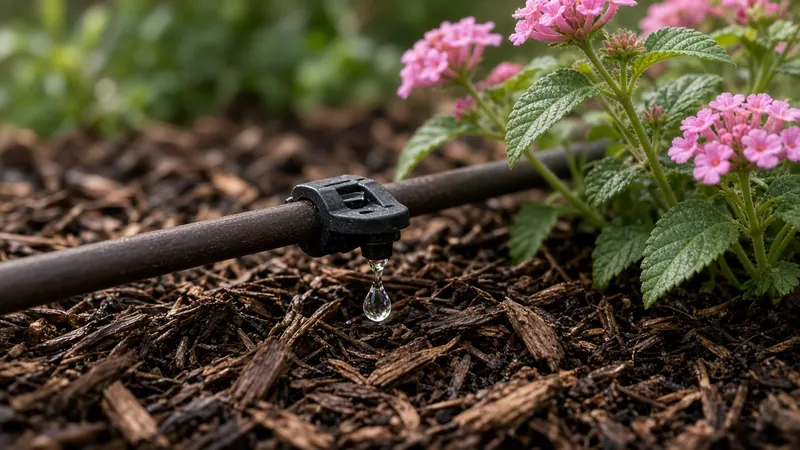
2. A dedicated irrigation zone. If you have a sprinkler system, add a drip zone around the house about 8 to 18 inches from the foundation. This is the approach we recommend most often, because it is automatic and separate from the lawn and bed zones.
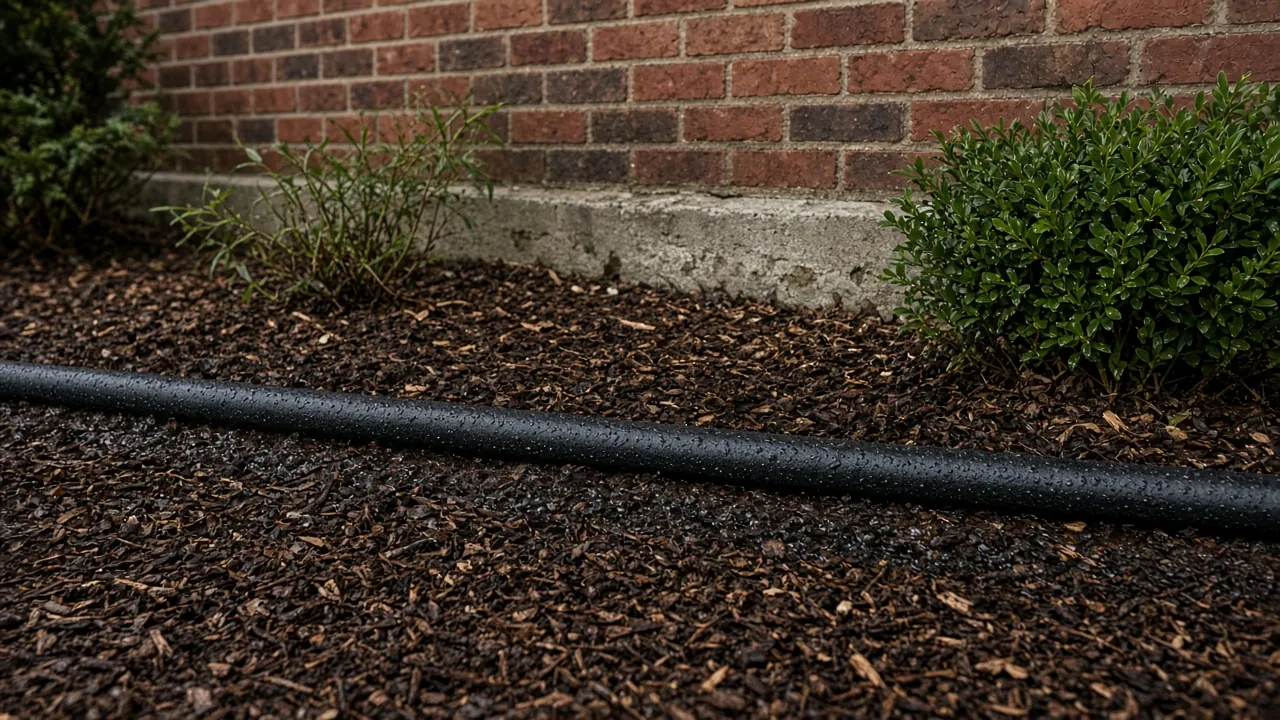
3. Drip or soaker hose on a faucet timer. Without an irrigation system, run drip line or a soaker hose around the foundation, connected to an outdoor faucet with a timer.

Setting up soaker hoses correctly
The AgriLife sheet’s soaker hose advice, in short:
- Place the hose 8 to 18 inches from the foundation, all the way around.
- Make sure there is a backflow preventer on the faucet before connecting anything. It keeps hose water from backing up into the house.
- Before the first use, take off the end cap and run water through to flush out debris.
- Soaker hoses work best at low pressure. Many have a small flow restrictor at the faucet end. If yours does not, open the faucet only enough that water seeps slowly.
- Run it for several hours.
- Do not water directly into a foundation crack.
For drip on a faucet, the sheet adds that you need a pressure reducer and a filter, because drip runs at low pressure and small emitters clog.
A drip zone is better than a soaker hose
Soaker hoses are cheap and they work, but they wear out, they leak unevenly along their length, and they get moved around. A dedicated drip zone with a filter, a pressure regulator and inline emitter tubing, buried under mulch at a set distance from the slab, is steadier and needs less attention. It also runs from your controller on a set schedule. Our drip for flower beds article covers what a drip zone needs, and our drip irrigation service covers installation.
What the watering rules say
Foundation watering by drip or soaker hose is treated differently from lawn sprinklers in our area.
- Dallas: the city says drip irrigation, soaker hoses and hand watering are allowed on any day and at any time, in its watering FAQ.
- University Park: residents can water at any time with a hand-held hose, a drip irrigation device, a soaker hose or a watering can, according to the city’s watering restrictions page.
- Highland Park: check the town’s water conservation page for current rules.
These rules can tighten during drought stages. The AgriLife sheet notes that if restrictions move to no outdoor watering, some cities may still allow foundation watering, and suggests checking your city’s drought contingency plan. Our watering rules guide covers the normal rules.
Do not let sprinklers do the job
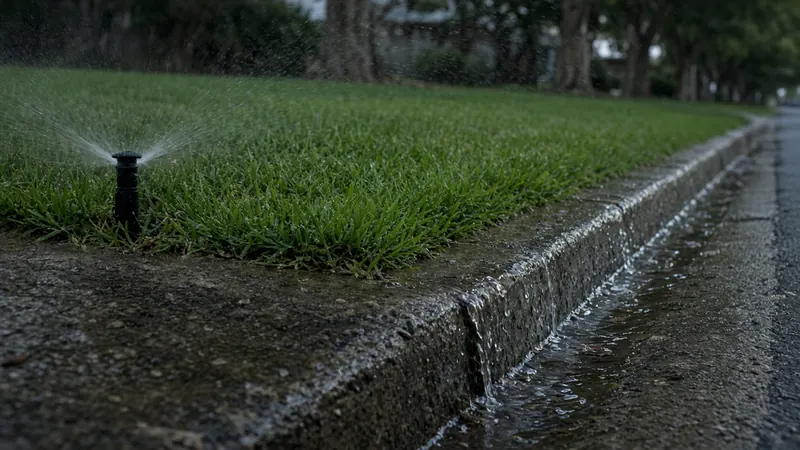
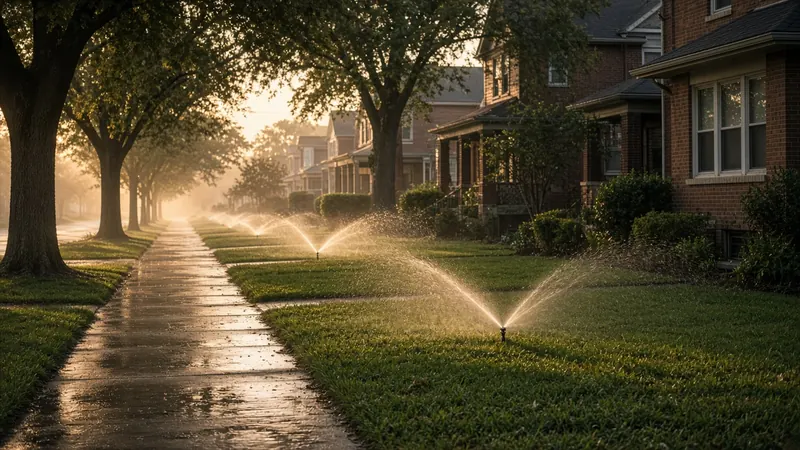
Spray heads aimed at the house are a poor way to water a foundation. They wet the brick and the windows, and new systems are not allowed to spray onto walls and other impervious surfaces under 30 TAC §344.62. They also cannot be installed closer than four inches to hardscape such as a foundation. Much of the water runs down the face of the slab and into the soil right at the edge, unevenly, which is not what you want.
Watch for too much water
Overwatering near the slab causes its own problems: soil that stays saturated, water running toward the house, and moisture problems in crawl spaces on pier-and-beam homes. Make sure the yard drains away from the house, gutters discharge away from the foundation, and no sprinkler zone leaves a wet strip along the wall. If one area near the house is always wet, check for a leak. See how to find a sprinkler leak.
A summer routine
- Check for a soil gap at the foundation every week or two in dry weather.
- Run the foundation drip zone or soaker hose regularly, for a long, slow soak.
- Keep mulch in the beds, but not against the slab.
- After rain, skip a cycle. A rain sensor does this automatically; see rain and freeze sensors.
- Look for wet spots, runoff toward the house, or cracks, and call the right professional for each.
If you want a foundation drip zone added to your existing system, contact us.
Sources
- Texas A&M AgriLife Research and Extension Center at Dallas, Protecting Foundations Under Dry Conditions (PDF)
- City of Dallas, Save Dallas Water FAQ
- City of University Park, Watering Restrictions
- Town of Highland Park, Water Conservation
- 30 Texas Administrative Code §344.62, Minimum Design and Installation Requirements
Have a question this did not answer? Call 469-902-9800 and ask. More articles on the blog.