A brown spot in a St. Augustine lawn has a handful of usual causes. Some are water: too little, too much, or in the wrong place. Others are insects or disease that look a lot like drought. Treating the wrong one wastes money, and sometimes makes it worse. Adding water to a lawn that has a fungus problem can spread it.
This article walks through how to tell them apart, in the order we check on a visit.
Step 1: Look at the pattern
The shape and location of the spot is the best first clue.
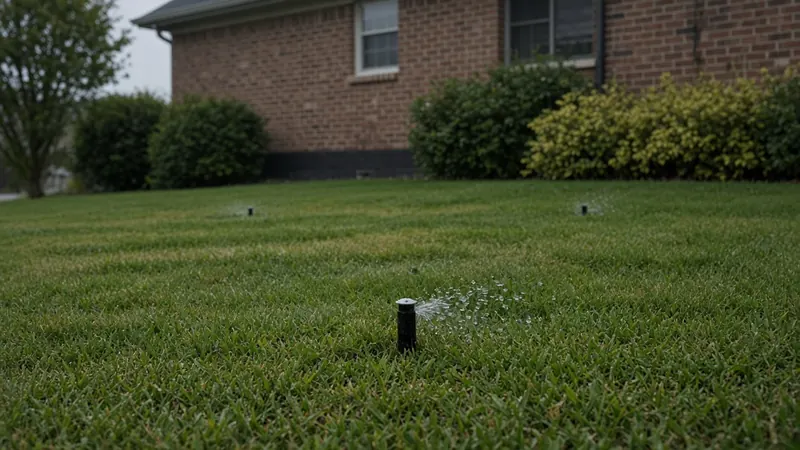
Brown in a ring or crescent around a head, or a strip between two heads. Classic coverage problem. One head is not reaching its neighbor, a nozzle is clogged, or a head is buried or tilted.
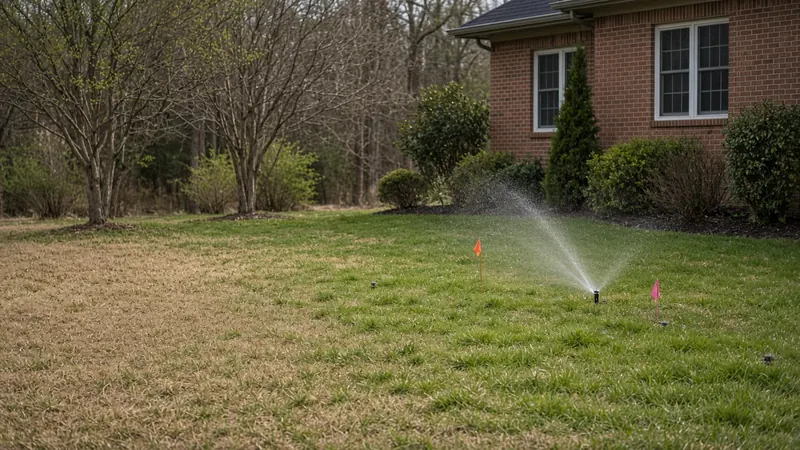
Brown at the far edge of a zone, or on a high spot or slope. Water is running off before it soaks in, or the far heads have low pressure. On clay this is very common. See cycle and soak for clay soil.
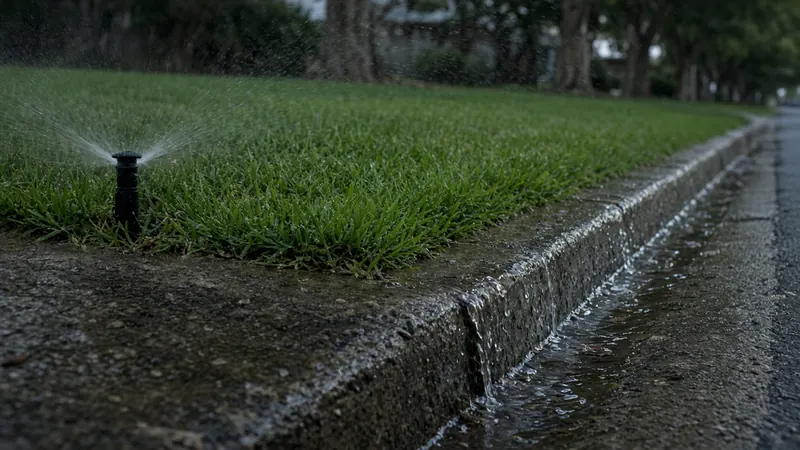
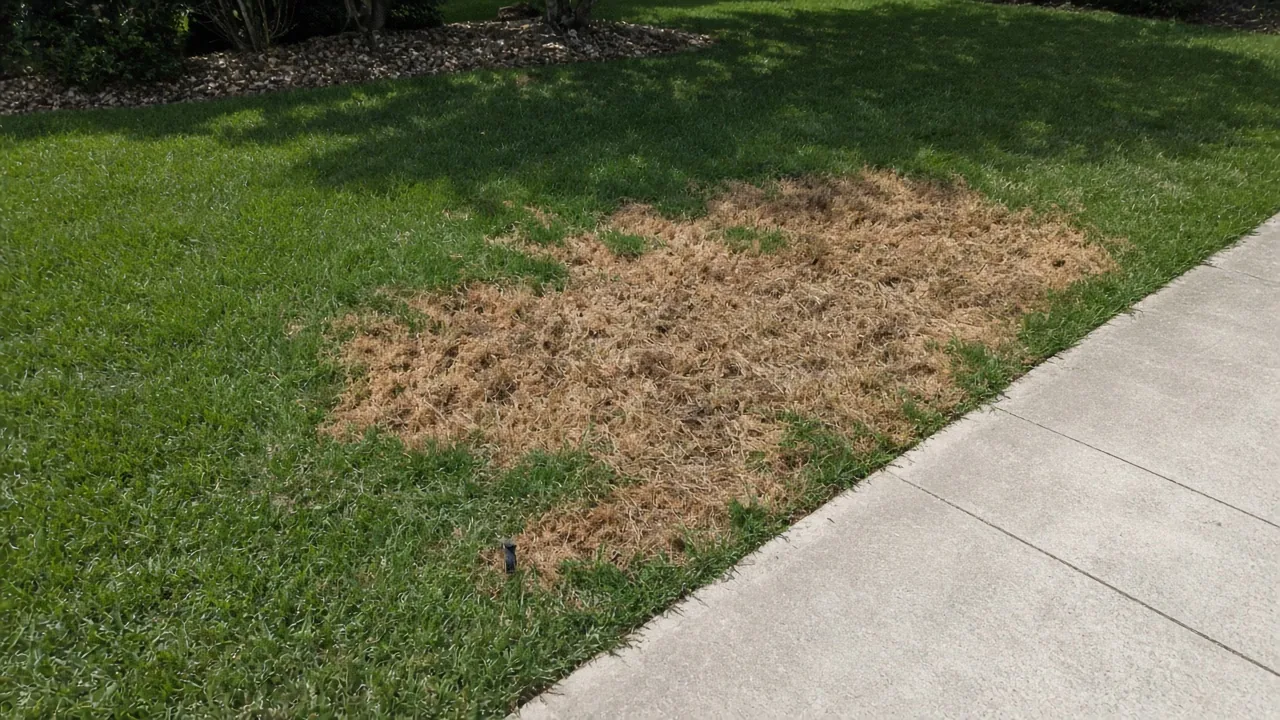
Brown along a sidewalk, driveway or curb. Pavement heats up and dries the grass next to it, and heads in narrow strips often spray the concrete instead of the grass. This is also where chinch bugs like to start, as below.
Brown in a sunny spot that spreads outward, with yellowing at the edges. Think chinch bugs.
Roughly circular patches in cool, wet weather, spring or fall. Think large patch.
Irregular thinning patches, especially in spring or early summer. Think take-all root rot.
Step 2: Run the zone and watch it
Turn on the zone that covers the spot and watch the whole cycle. Look for:
- A head that does not pop up, pops up partway, or sprays weakly. See low water pressure on one zone.
- A head blocked by grass, a shrub, or a new planting.
- A nozzle that is aimed wrong, or spraying the sidewalk.
- Spray patterns that do not overlap. Heads should throw water to the next head.
- Water running off the surface.
If you see a coverage gap that matches the brown spot, you have your answer. Our broken head repair and sprinkler repair pages cover the fixes.
Step 3: Check the soil
Push a long screwdriver into the soil in the brown spot and in a green area nearby, a day after watering. In moist clay, it slides in several inches. In dry clay, it stops near the surface.
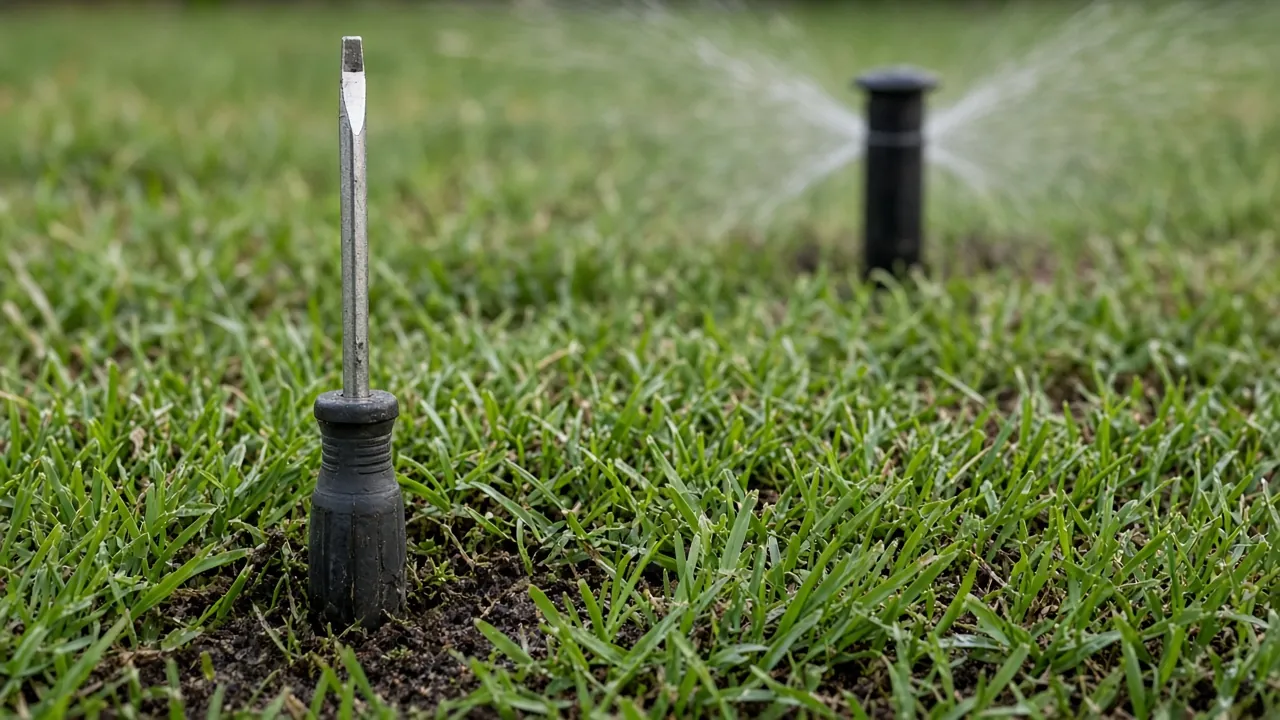
- Dry in the brown spot, moist in the green area: water is not getting there. Go back to coverage.
- Moist in both: water is not the problem. Look at insects and disease.
- Soggy in both, with a sour smell: too much water. Overwatering in shade, or a valve leaking through after the cycle, can do it. See a zone that won’t shut off.
Step 4: Rule out chinch bugs
Texas A&M AgriLife describes southern chinch bug damage in St. Augustine as expanding, irregular patches of dead or stunted grass, often surrounded by a halo of yellowing grass, developing quickly in sunny spots during hot, dry weather, in its chinch bug fact sheet. They often start near driveways and sidewalks where the grass is hottest.
To check, part the grass at the edge of the damaged area, where brown meets green, and look at the base of the plants. Adults are tiny, with black bodies and white wings. Nymphs are smaller, wingless, and yellow to pinkish red. AgriLife’s southern chinch bug publication has photos.
Chinch bug damage does not respond to more water. It is an insect problem, and AgriLife’s guidance focuses on reducing thatch, avoiding excess fertilizer and treating when bugs are present.
Step 5: Rule out large patch
Large patch is a fungus, Rhizoctonia solani, and AgriLife calls it the most chronic disease of St. Augustine in Texas. It shows up in spring and fall when temperatures are below about 70 degrees and the soil is wet, according to AgriLife’s large patch publication.
The signs: circular patches with orange or yellow borders, and grass blades that pull out easily from the stem. That pull test is the practical field check AgriLife describes.
AgriLife lists over-irrigation, poor drainage, late-fall fertilizer, low mowing and excess thatch as conditions that promote it. That means a sprinkler schedule can contribute. If a lawn has large patch in the fall, cutting back run times as temperatures drop is part of the fix. Watering more makes it worse.
Step 6: Rule out take-all root rot
Take-all root rot is a soil fungus that affects St. Augustine. AgriLife’s take-all root rot publication describes yellowing leaves that turn brown, thinning turf, and irregular brown patches from 1 foot to more than 20 feet across, often appearing in spring or early summer. Roots are short, dark and rotten, and runners lift easily from the soil.
AgriLife also notes it is easily mistaken for large patch or chinch bugs, so rule those out first. Its management guidance includes good drainage, deep and infrequent watering rather than frequent light watering, and balanced fertility.
Step 7: Consider shade, roots and pets
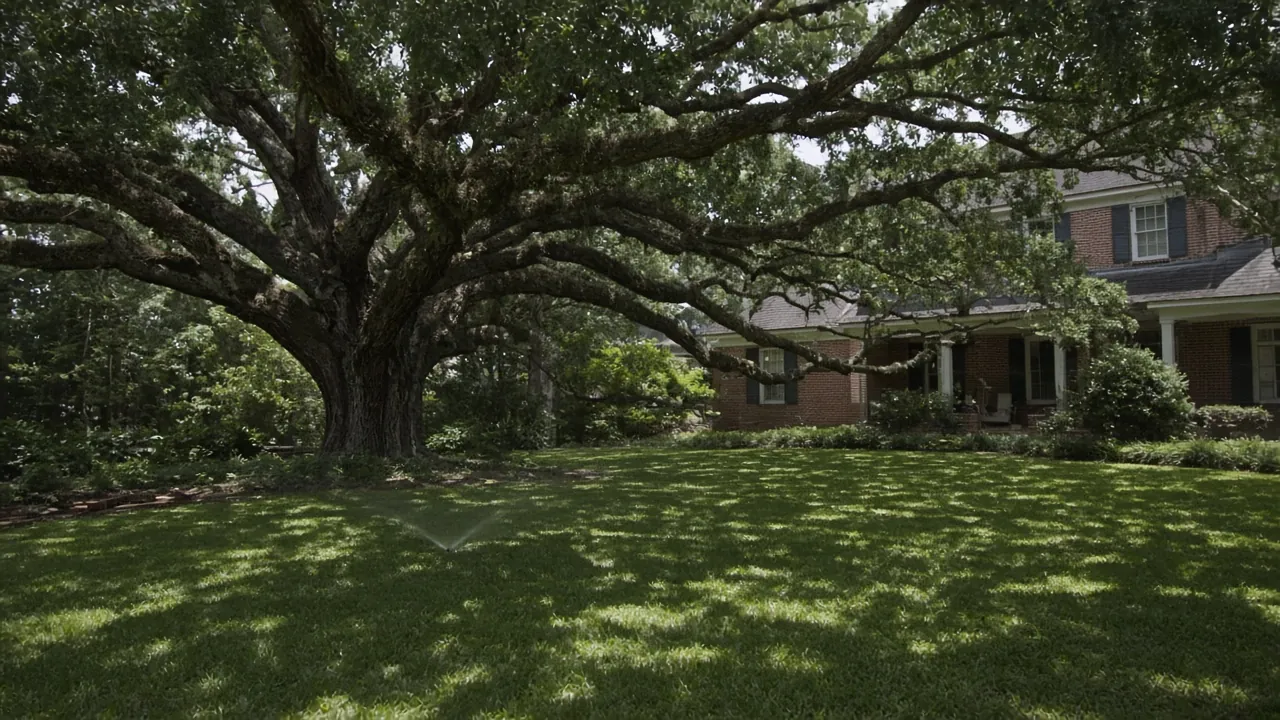
- Shade. St. Augustine is the most shade-tolerant warm-season grass, according to AgriLife’s St. Augustine lawn management guide, but deep shade under old oaks and pecans still thins it out. More water does not fix shade.
- Tree roots compete for water and can lift heads out of position.
- Dog spots are small, round, and often have a ring of darker green grass.
- Buried debris, like a slab, rock or old construction material, makes a spot that dries first every time.
Putting it together
| What you see | Most likely cause | First thing to try |
|---|---|---|
| Dry ring or strip between heads | Coverage | Run the zone, fix heads and nozzles |
| Dry at slope or edge of zone | Runoff or low pressure | Cycle and soak, check pressure |
| Moist soil, spreading patch in summer sun | Chinch bugs | Inspect at the edge of the patch |
| Circular patch in cool wet weather | Large patch | Pull test, cut back watering |
| Irregular thinning in spring | Take-all root rot | Rule out the others, improve drainage |
| Soggy soil | Overwatering or a leak | Check schedule and valves |
If the sprinklers look fine and the soil is moist, the next call is to a lawn care professional or your county AgriLife office, not a sprinkler company. If the problem is water, we can help. Contact us or read our watering guide.
Sources
- Texas A&M AgriLife Extension, Chinch Bugs in St. Augustine Lawns (PDF)
- Texas A&M AgriLife Extension, Southern Chinch Bug: Identification and Control (PDF)
- Texas A&M AgriLife Extension, How to Diagnose and Manage Large Patch Disease
- Texas A&M AgriLife Extension, Take-All Root Rot in Turfgrass
- Texas A&M AgriLife Extension, St. Augustinegrass Lawn Management (PDF)
Have a question this did not answer? Call 469-902-9800 and ask. More articles on the blog.